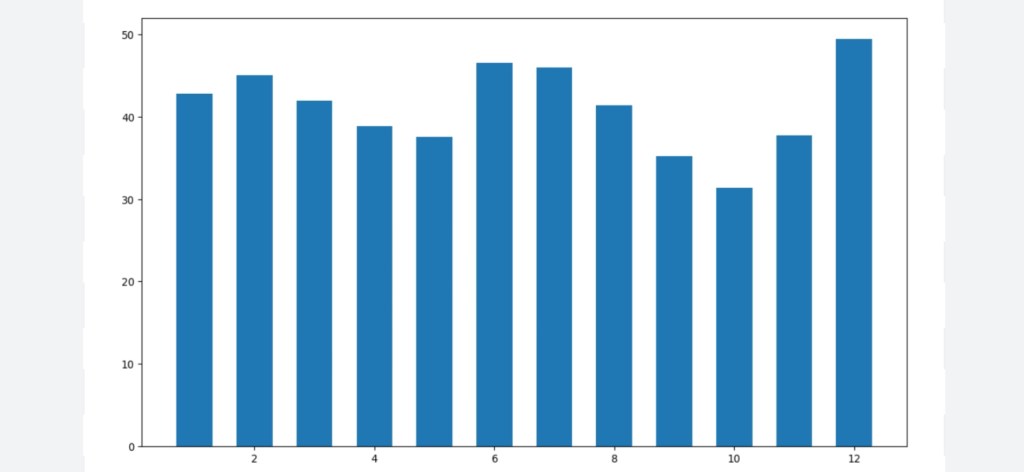
The question is “Do I really need bar graphs in my life?”
Yesterday was September 1. A month ago, when the page turned to August 1, I did what my obsessed self had done for years. I checked the WordPress site to see how many views I had for my posts. Then there was the process of odious comparison:
July, 2023 vs. June, 2023
July, 2023 vs. each of the other months in 2023
2023 vs. 2021 (see the note below)
2023 vs. each of the other years since 2014
(Actually I exaggerate. I wrote a post on September 29, 2021 … and not another one until January 30, 2023. Sixteen months of absence … but you get the idea.)
***
I am fascinated that today (September 2, 2023) I have no interest in seeing how many of you tuned in during August. The “have to” is gone. My ego is no longer invested in whether the number is 800 or 100. If the number was 2, then I would get antsy but I know it’s far larger than that.
Where did the need go? It’s true that I’d told myself to stop looking at daily and monthly stats, and that I’d often cheated at the beginning. But now the whole topic of conversation has floated away.
I’m curious. I’m not analyzing, as in “What does it mean?” or “How can I apply this to other areas of my life?” I’m simply in wonder.
There are about eight billion of us. How many have done something that’s never been done before? I wonder.
***
In 1954, Roger Bannister was a medical student in London, England and a member of his university’s track team. On May 6 he and his teammates were in a mile race against Oxford University.
Four minutes had long been considered an impossible barrier. Roger ran 3:59:4. And there was a shift in consciousness on the planet.
***
During the 1968 orbit of the moon by the Apollo 8 spacecraft, astronaut William Anders took this photo, aptly named “Earthrise”. Suddenly A looking at B had become B looking at A. Millions of people just stared. And there was a shift in consciousness on the planet.
***
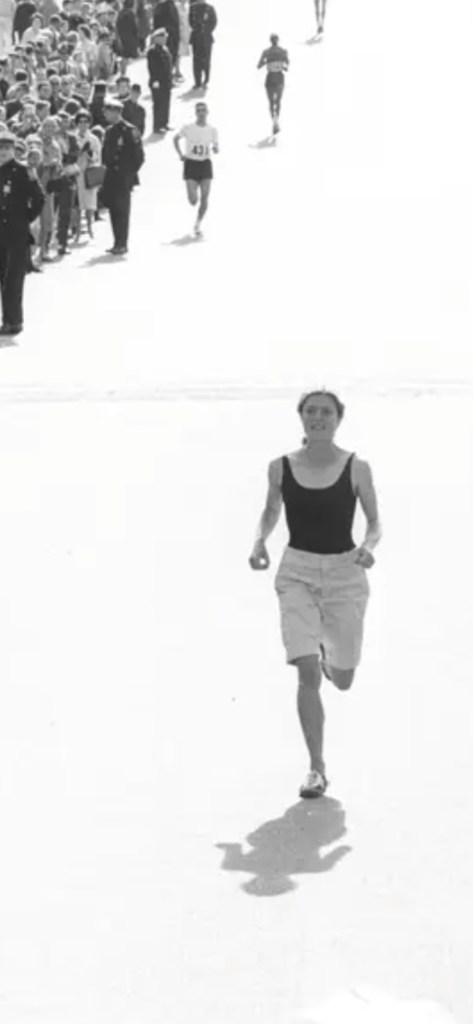
“Before 1966, the longest Amateur Athletic Union-sanctioned race for women was one-and-a-half miles.” In April of that year, Bobbi Gibb blew that idea to smithereens. She ran the Boston Marathon (26.2 miles) … and completed it. This despite the prevailing wisdom that “women are not physiologically able to run a marathon”.
And there was a shift in consciousness on the planet.
This from a recent Facebook post:
Bobbi Gibb hid in the bushes and waited for the race to begin. When about half of the runners had gone past, she jumped in.She wore her brother’s Bermuda shorts, a pair of boy’s sneakers, a bathing suit, and a sweatshirt. As she took off into the swarm of runners, Gibb started to feel overheated, but she didn’t remove her hoodie.
“I knew if they saw me, they were going to try to stop me,” she said. “I even thought I might be arrested.”
It didn’t take long for male runners in Gibb’s vicinity to realize that she was not another man. Gibb expected them to shoulder her off the roador call out to the police. Instead the other runners told her that if anyone tried to interfere with her race, they would put a stop to it. Finally feeling secure and assured, Gibb took off her sweatshirt.
As soon as it became clear that there was a woman running in the marathon, the crowd erupted – not with anger or righteousness, but with pure joy, she recalled. Men cheered. Women cried.
By the time she reached Wellesley College, the news of her run had spread, and the female students were waiting for her, jumping and screaming. The governor of Massachusetts met her at the finish line and shook her hand. The first woman to ever run the marathon had finished in the top third …
In late September I begin Dutch lessons at an adult education centre called CVO Gent. I’ve seen pictures but today I want to go there.
There are two main options for transportation – using my feet or taking the tram. Google says walking will take between 25 and 29 minutes, depending on my route. I walk slower than the Google computer. Here’s what Option One looks like:
And here’s Option Two: walk four minutes, tram for five minutes, walk nine minutes. This one gets me to CVO at least seven minutes faster. It provides at least twelve fewer minutes of fitness. And it costs four euros more (4€ vs. 0€).
I’m not big on lists of pro’s and cons so I’ll go elsewhere. What do I get about which way to go?
Walking. Uninterrupted flow. Slow. Gentle.
***
The second choice concerns the route I take. The blue dots take me along the Leie River … very scenic. If I came back the same way, my travel time would be 25×2 minutes = 50 minutes. The fastest. But what exactly would I be saving time for? This route gives me access to fewer of Ghent’s wonders.
Then there are the two paths shown by grey dots. I’m thinking of a quote from a poem called “The Road Not Taken”. It was written by Robert Frost, an American poet:
Two roads diverged in a wood, and I I took the one less traveled by And that has made all the difference
I’ve walked some of the route represented by the right vertical line of grey dots and virtually none of the left one. So do I travel back and forth on the leftmost streets?
What comes is saying no to all of the choices where I’d retrace my steps on the way back home. What comes is the beauty of a circle … going out into the world, looping around, and returning to the source by another path. There’s a mystery in the returning to something, and knowing it newly.
***
Perhaps this mixture of philosophy and walking seems strange to you. Or maybe it’s calling you home. No matter.
I’m about to set off on my journey
I’ll tell you tomorrow of the wonders that come my way
My guitar. It sits behind the couch, on the opposite side of the fireplace from my cello. And it hasn’t been touched for a long time.
Pressing the strings with fingers is needed. Songs and chords and flat-picking are in my future … such as in a few hours.
I took group guitar lessons in Ottawa, Canada in 1972. Is that really fifty years ago?
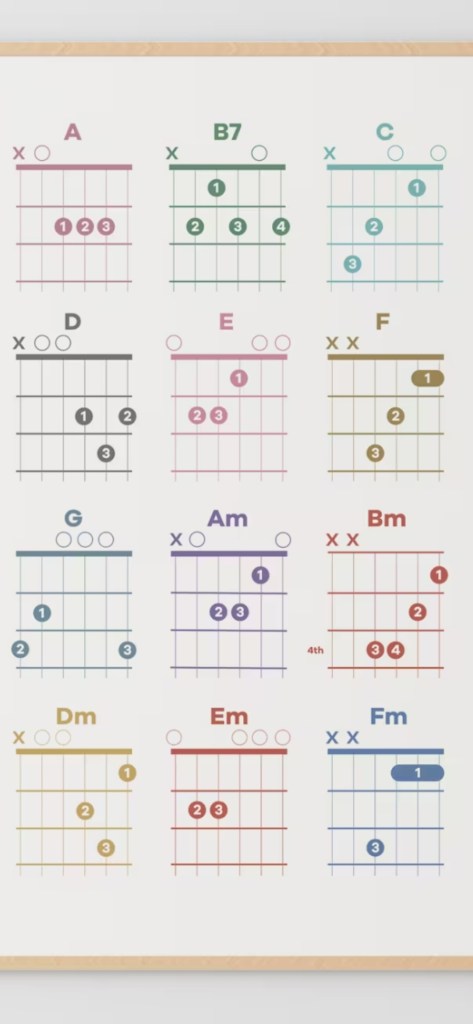
Way back then, and later today, I played only in the key of C – three major (or happy) chords (C, F and G) and three minor (or sad) ones (D, E and A). You can make a lot of cool music with those six! Here’s what they look like on the fingerboard, along with six cousins:
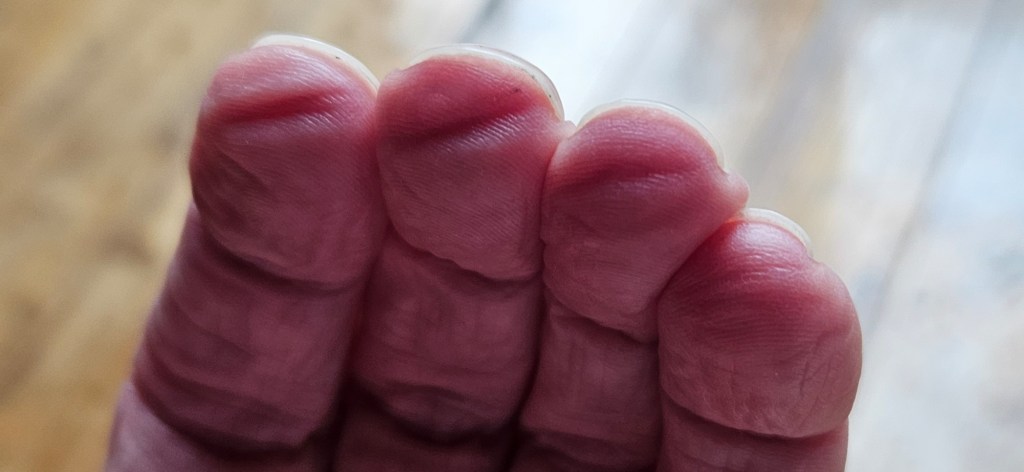
What the diagram doesn’t show you is … pain. The calluses on fingers 1, 2, 3 and 4 disappeared centuries ago. The tips are now sweet softness, not tough enough to press the strings hard for more than a few minutes. Oh well. Time will show me the way.
Back in my 20s, I thought I would learn to finger pick one day – practicing different patterns of right hand finger movements to create a complex sound. Now I have no interest. My flat pick, held between the thumb and first finger will do the job well into my 90s. Here are twelve of them:
And then there’s tuning the guitar. I just looked it up on the internet and the method returned to my mind. Tune the lowest string (E) to a piano or an electronic tuner and then press your finger on the fifth fret of the tuned string to give the correct pitch for the next one. Clear?
I can do this.
I’m all set (sort of). I’ll report back later in the day about how the new guitar playing turned out. As they say … “stay tuned”.
***
Oh my. My fingers remembered the chord shapes – so imperfectly but they’re still in my cells.
I decided to sing and play “Someday Soon”, written from the perspective of a woman and sung by this man!
The first chord was C Major. It was nice and bright. It went with the words “There is a young man that I know.” I could feel that the next phrase “And his age is 21” required a minor chord. I tried E Minor. No, that was wrong. Then A Minor. Yes!
I worked through the lyrics, finding the right chord for each moment. Lots of trial and error. The fingers of my left hand mostly landed on the right spots … with a pleasing sound. But sometimes not. “That’s not the chord!”
I could feel my strength waning. As the fingers couldn’t press the strings as hard, the sounds went buzzy.
Here’s what my digits looked like after a few minutes of playing:
Groovy! And not a callus to be seen.
I just strummed the strings with the flat pick. Picking individual strings sounds far better but I’m not ready for that.
The scene is a shoemaker’s shop in Toubacouta, Senegal. As the craftsman worked on my floppy sole several weeks ago, I sat and marvelled.
We’re so many colours, we humans … both inside and out. How can anything in the world be more luscious than turquoise? And yet a reddish brown fills my heart with delight.
We’re so many sizes – tall or short, fat or thin. The shortest of us can stand so tall when courage is called for. And when our foot slides easily into a sandal, somewhere there is a sweet companion who fits the other one perfectly. Have we found this beloved? Perhaps not.
And how about styles? Boots that lace up to the shin … brown loafers that invite the foot to loaf … high heels for the party … cozy slippers for the evening hours. Walk down the street in Ghent and you’ll see crop tops, capes, striped pants and hijabs … plus the magnificent beings who occupy these garments.
I remember hearing in my Bible days about Jesus washing his disciples’ feet. Many “religious” people were aghast that this Jewish preacher would stoop so low.
But Jesus knew. The feet are our foundation. They need to be revered
UPDATE: I got it wrong! Luc just texted me to say that this painting was created by a Canadian woman – not René Magritte. That’s right. We talked about two painters. I’m laughing. I won’t change the title … just for fun.
This afternoon I was sitting on the terrace of the t’Kanon café in Ghent with my friends Lydia and Luc, letting both the sun and the conversation enter me.
My body was tired from a workout on the elliptical at the gym. I was still feeling the emotional effects from my esophagus procedure. And battles with my internet service provider to get good TV reception were wearing me out.
Part of me wanted to be alone in the silence of my room but the larger me had friends to celebrate life with. Here they were, right before my eyes! Not to be missed.
Either Luc or Lydia mentioned René Magritte. I hadn’t heard of him. Then Lydia showed me one of his paintings on her phone:
From Google:
“René Magritte was a Belgian surrealist artist known for his depictions of familiar objects in unfamiliar, unexpected contexts, which often provoked questions about the nature and boundaries of reality and representation.”
Indeed.
My eyes opened. My fatigue was gone. René was talking to me. A man who died in 1967 was reaching across the years.
Everybody is dancing. The rhythms of living were demanding that the folks move … and groove. The couple in the middle are given lots of space to show their stuff. The rest of the dancers are happy to yield centre stage.
This is fast dancing. It looks like they’re jiving. The faces contorted, the eyes wide, the sweat pouring. Everything exploding at once.
I could live this way. I could rise above snakes in my throat, blurry television images, and the ache in my knees as I stretch. I don’t like any of those things but who said they have to define me? Not I!
***
Thank you, René … wherever you are
You came to visit at a perfect time, just like Lydia and Luc
I love playing piano. I bought a keyboard months ago. Rarely do I sit down and tickle the ivories.
Something needs to be done.
The conditions are perfect for playing. Many sounds are available with the touch of a few buttons: grand piano, church organ, strings … even a harpsichord.
The piano sits in front of a window looking out over my back terrace. The river is nearby. Even though I can’t see the water, the gulls love the route. In the distance are slate rooves. People live under them!
What will have me return to playing? It’s simple … I’ll promise you that I will. You won’t like it if I break my word.
So …
Today I will sit at the keyboard for an hour – and play it! I’ll choose a sound that I like and figure out how to input it. I’ll take one of the songs that I’m relearning (Did She Mention My Name?) and work at playing it in the key of C, which is the easiest for me – no black keys.
After all this happens, I’ll return to my phone and tell you all about it. I promise.
It’s 10:44 am.
***
It’s 3:25 pm.
I did it! An hour plus of figuring out the keyboard manual and actually playing. The manual has been sitting on my dresser for a long time. I’ve looked through the pages before and sagged in the face of all the details.
Today I realized something: English is only one of eight languages in the book. Could its mere thickness have been an unconscious barrier deterring me from exploring its mysteries?
In any event, today was the day. I figured out how to listen to different sounds, and I probably heard fifty of them while playing an F chord. And I found two favourites: “ConcertGrand+EP” and “Deep Strings”. The first has a rich, layered piano sound and the second includes the tones of my beloved cello.
I knitted my brow in concentration as the manual coached me about “Favorites”:
1. Select the Scene you want to register
2. Press the FAVORITE [BANK] button to make the indicator button light
3. Press a [0]-[9] button to select the registration-destination bank
4. Long-press the FAVORITE [ON] button to make the [0]-[9] buttons blink
5. While continuing to hold down the FAVORITE [ON] button, press the [0]-[9] button in which you want to register the selected scene
I did it again! I can figure out words.
It turns out that what my fingers remembered was the key of F, not C … three major chords and three minor ones. One black key along for the ride.
I started the melody of Did She Mention My Name? and felt into what the left hand should be doing in harmony. So far I can’t read piano music. It’s always been my ear that’s done the job.
Lots of right notes … and lots of wrong ones. Chords that worked with the melody and ones that didn’t. “Keep exploring, Bruce!”
“Oh my God – Lightfoot’s song is coming out of my fingers! What a good boy am I!”
Then what came were the notes of All Through the Night – a lullaby. And I was being lulled.
The Vuelta a España is a 21-day road cycling race in Spain … 3153 kilometres (1959 miles). It starts on Saturday, and I’m ready with my TV remote!
This year seven of the stages cross or end on high mountain passes.
Stage 17 on September 13 finishes atop the feared Alto de l’Angliru. It’s 12.5 kilometres (7.8 miles) of climbing, with a total gain in altitude of 1266 metres (4,154 feet). The average gradient is 10.1%, with the maximum slope 24%!
Let those numbers sink in. How can human beings do what these 176 riders are about to?
To help you, here’s a photo of one of the steepest sections of the Angliru:
And just for fun, here’s one more:
Riding a bike is no longer part of my life. I’ve made my peace with that. But I have the soul of a cyclist. I will watch the pumping legs on TV. I will see the mouths sucking air on the climbs, the sweat pouring off the foreheads.
Nine days ago I was sitting innocently on my couch when my throat started constricting. Saliva kept building. I swallowed a lot. Many glasses of water later, I fell asleep.
Eight days ago, my throat tightened again. After a silly debate inside my head about whether this was an “emergency”, I walked to the AZ Sint-Lucas Hospital. A referral to the Gastroenterology department. A second visit to Emergency that morning yielded a bunch of tests and a new medication.
My appointment with Gastroenterology was yesterday afternoon. Google Maps wasn’t working right and I stumbled around towards the main entrance of the hospital. Magically I got there on time.
I couldn’t figure out the registration instructions at the kiosk but a receptionist was right there to translate.
Now the waiting room. Now shaking hands with Dr. Cesmeli … a nice guy. Lots of questions, my best answers. And then:
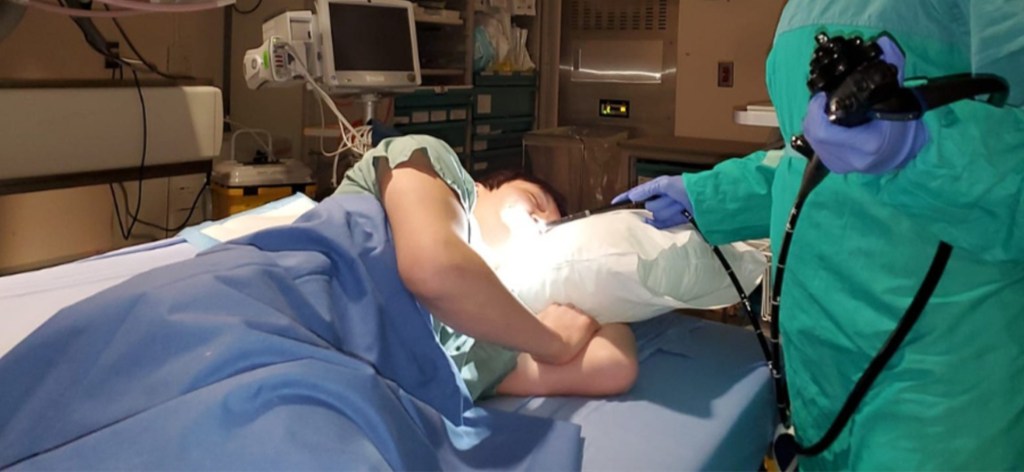
“I’ll be sending a camera down your esophagus. It will be uncomfortable but it will only last three minutes.”
I don’t do well with pain. I imagine you don’t either. I swallowed … in my throat and in my heart.
The photo is accurate. Lying on my left side, something tied around my mouth to keep it open. The nurse sprayed an anaesthetic into my throat. The numbing was fast.
As I fretted about the future of my life, I saw what the doctor was holding. It was a black, flexible tube with a clear section at the tip. A camera. I’m probably exaggerating here but it looked to be a centimetre in diameter. “Oh no!” bubbled up in my brain.
“I should be stronger. I should be stronger.” Except I’m not. Recent experiences of not breathing easily created terror in my soon-to-be-entered throat.
In went the snake …
“Swallow,” said the doctor.
Down deeper …
“Breathe slowly,” said the nurse.
Panic felt I. And then slowing my breath …
I could feel something turning inside, and how tight things were down there. It felt like the tube was approaching my heart.
“Breathe,” I said to my soul …
Finally an impossibly long three minutes was over. The snake retreated into the open air.
I slumped. I felt the anaethetic filling my throat.
“Don’t worry. The numbness will be gone in twenty minutes. Come to my office after you’re feeling better.”
***
Okay, Bruce.Thousands of humans have experienced what you went through. They probably all felt the jolt when the tube started down. Many were scared, just like you. You’re a part of this very human family, not some anomaly.
Dr. Cesmeli said that there’s a constriction in my lower esophagus, probably associated with acid reflux. The medication will relieve that … some or a lot. There’s also a bit of fungus down there, which should disappear with the meds.
If the tightness, saliva growing, and constant swallowing return, he will do a small cut in my esophagus and widen the tissues.













 Bruce's Blog