Recently I was mean to a dear friend of mine. I spoke and acted unkindly. “That’s not you, Bruce,” I thought. Except this time it was.
Years ago, I vowed to Do No Harm. And usually I keep my word. So yesterday and today I’ve been sitting with having broken that agreement. Feeling into the pain of it. I’m an imperfect human being who wants to give to others and sometimes doesn’t.
Will the person forgive me? I hope so. And … will I forgive myself? I’ve been working on it. It used to be that when I screwed up, I lost weeks or even months in the angst of it all. Let’s go for a few days this time.
***
This morning, I was chatting over the counter to one of the employees at Panos Langemunt while ordering my breakfast.
Off to the side were gasps and cries. A young woman was stumbling against the drinks cooler, her eyes glazed. She was muttering something in apparent delirium.
Two other women had her by the arms to prevent a fall. A guy was already on his cell phone, calling 112. A woman employee was rushing in with a chair.
There were at least fifteen of us focused on the disoriented woman. I sent her all the love that resides in my heart. All of us were an instant family.
Minutes later, as EMS were arriving and her eyes started to focus, she and I looked at each other. I bowed with my palms together. She smiled.
This is Maddy Nutt. She’s a British gravel bike racer. And she spoke at last week’s Rouleur Live convention in London. I was in the front row.
She’s pretty … and that’s nice. But there’s a world beyond in this woman. She glowed as she talked, and as she listened to others onstage.
Rouleur magazine wrote an article about Maddy recently:
When people told her that her dream of becoming a professional gravel racer was fanciful, and questioned her choice to wave goodbye to the career she had worked hard for [in finance], Nutt did it anyway.
…
Completing a stacked calendar of gravel events has taken Nutt all over the world – she’s raced in Australia, Mexico and Africa this season alone. Nutt seems to thrive on tough terrain and come into her own when the limits of her endurance are tested.
Maddy:
“The race started pretty fast and I did crash quite hard, but I immediately got back up and was determined. I knew my legs were good and I couldn’t lose this opportunity. I was away with one of the Rwandan riders and on a key climb I knew I could push hard to get a gap, then try to keep everyone out of sight. I paid for it later because my legs were so wrecked and I ended up getting cramps. But because I was winning, I was too stubborn to get off the bike. All I had to do was somehow keep the momentum going and not crash on slippy sand. It was hard and I was panicking that someone was going to catch me. I had a few hundred metres to go and I started crying because I was overwhelmed by winning the race, but also in so much pain.”
And here’s another photo … different than the first:
So said the pouting voice inside my head. I just came from my Music Theory class at the Poel school. And often I was mixed up, stumbling around in my mind.
I realize that you the reader may find the tasks that I’ll describe easy. If so, good for you. We’re no less or more than each other. Thank God we’re not all the same.
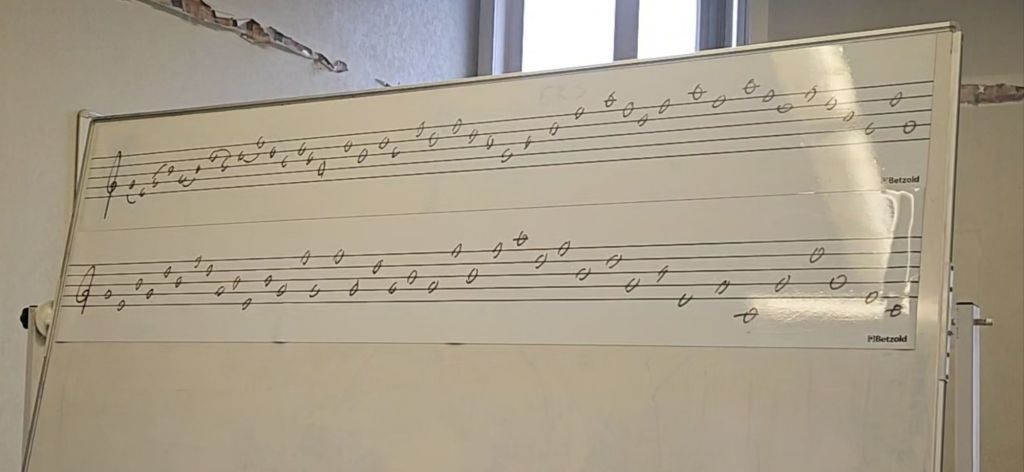
Here’s the first task:
A whole bunch of notes in the treble clef. Most of the intervals are thirds, occasionally a fifth or seventh. We read them aloud (do, re, mi etc.). And we do it fast. Oi!
If I fall behind the class rhythm, because I’m thinking rather than flowing, there’s no catching up. I wonder if my struggles have something to do with having an older brain. But who cares? I’m pumping out the notes. Good for me.
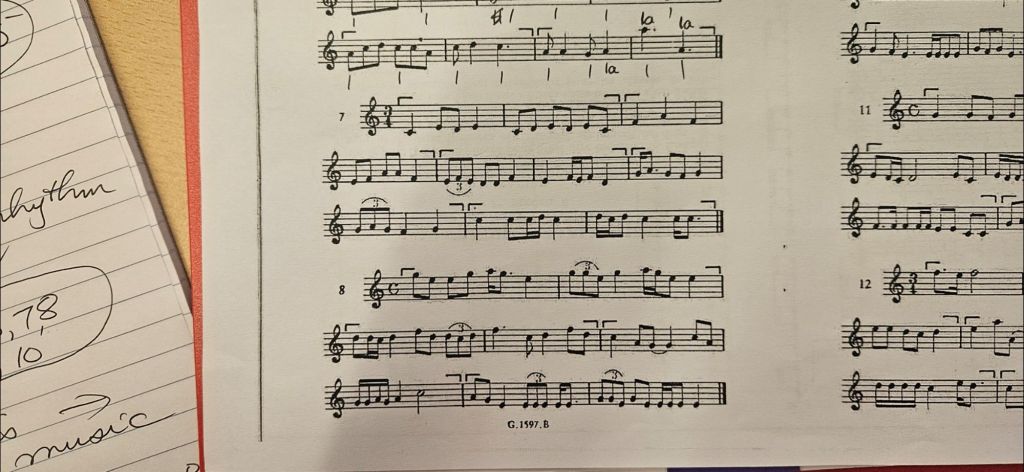
Here’s task two:
Hopefully you can enlarge the image.
Today we focused on exercises 7 and 8. First we tapped out the rhythm, saying “Bah” for each note. Then we named each note (do, re, mi …) without a rhythm, and without saying any repeated note. Oi again. Finally we named the notes in the correct rhythm. (Or at least the teacher and some of the students did!)
I’m laughing. All is well in the humility of the moment.
Each of us in the class studies a musical instrument at Poel. For me, it’s the triangle. (Okay, I lied – it’s the cello.) Patrick, our teacher, says these exercises will help us play with a greater flow, feeling a series of notes rather than one by one.
It’s like learning to read. You start with B – O – O – K and eventually you sense a book. Then a sentence, a paragraph … and a story. And perhaps my cello playing will eventually emerge more like poetry than prose.
We went out to a Turkish restaurant for dinner last night – Christine, Abbas and me. They’ve loved each other for decades, and you can tell … they’re quiet together.
The first story is the flavours. Oh … the moussaka! And even more so, a dessert called antoic kunefe. My mouth sang but my brain couldn’t figure it out. So the Internet to the rescue …
The künefe’s thin, string-like strands of crunchy semolina dough called tel kadafıy combined with its unsalted stretchy Hatay cheese provided an ideal contrast of textures, while the sherbet (a syrup made of water, sugar and lemon juice) that was poured on top lingered in our mouths.
The second story is Abbas. He’s from Iran. When he speaks, Christine describes him as “poetic”. I agree. The lilt of his voice soothed me.
I have a marvelous Iranian friend called Hana so I’m not stuck in a stereotype about the country. Still, Abbas opened my eyes when he said that over half of Iran’s post-secondary students are women, and there are a lot fewer hijabs worn than I would have guessed.
A fine time was had by us three and our smiling server gentleman
***
Now it’s lunch at Heathrow Airport Terminal Five – yummy soft tacos. I had bought a return bus ticket “Heathrow/Paddington train station”. When I got to Paddington, I reasoned wisely that buses would be parked outside of the station. So I went out and started circling the block. No buses.
Where do they hide the buses!?
I approached a fellow wearing an orange uniform.
Where can I find the Heathrow Express bus?
It’s a train, not a bus. It’ll be on Track 6 or 7 in the terminal
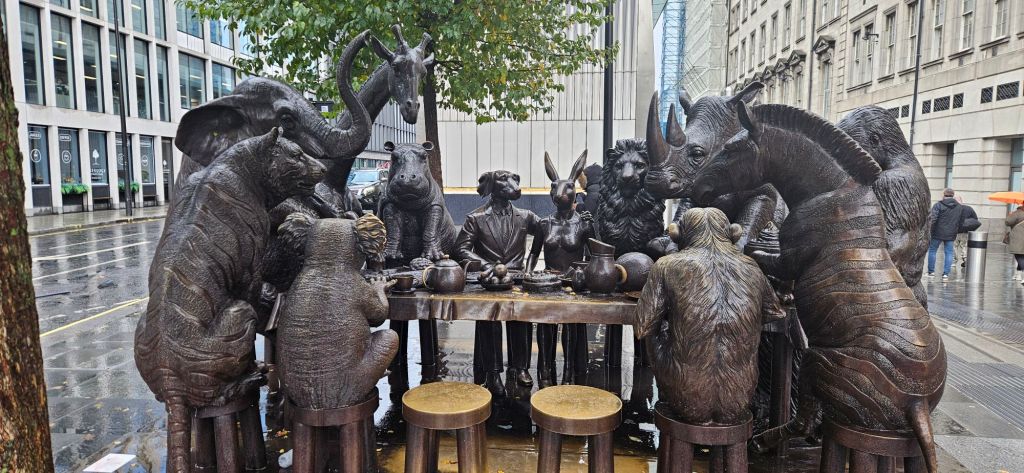
Oh. So much for my memory of arriving in London. The good news is that I came upon a marvelous sculpture when I was on the street at Paddington:
It’s called The Wild Table of Love. And there’s room for all of us to sit down and share a meal.
I was boarding just now and came across another fine image. I won’t add to it. Just take a look …
Today was momentous. I met my friend Christine … for the first time. We’re members of the Evolutionary Collective, an organization which meets on Zoom, with participants far and wide in the world.
When Christine was in the EC’s teacher training program, I was the Zoom host for one of her courses. We worked well together, and deeply appreciated each other’s gifts.
We set it up to meet for lunch at the Market Coffee House in East London. As I awaited her arrival, I told the young server about our story. She too was excited to know that very soon Christine would be opening the door.
I had a touch of nervousness … hardly anything. Mostly I was thrilled to open a new chapter of friendship.
We’ve had fine talks for the past few hours, interrupted by us being on an Evolutionary Collective call for an hour. I saw Christine’s rectangle on the screen, with only two doors between our actual rooms. Very fun.
Christine’s husband will be home soon and we’ll be heading off to some restaurant to celebrate life.
I suppose I should take photos of London so you get a sense of place. Maybe later today. But I’m not drawn to the buildings and street scenes. I’m drawn to the conversations.
I like saying hello. Often when I say “Good morning” here, the response is “All right?” Cool. When in Rome …
I’ve eaten twice at a tiny breakfast place called The Café. It’s run by a beaming Turkish man named Saza. He welcomes everyone – regular or stranger. Exactly what the world deserves.
I’ve watched Saza as he sees someone he knows approaching the restaurant. Before they hit the front steps, he’s launched into making their drink.
I asked him about knowing the regulars’ beverages. How many people? > “100? Maybe 200.”
Wow.
***
On the tube yesterday, I saw a young mother with a very young daughter. I couldn’t hear the words well, but mom was asking a lot of questions starting with “Is it …?” The girl threw her hands in the air again and again, laughing and saying “No, No!” They were both having fun.
As I got up to leave, I leaned over to the woman and said “Good mom”. She smiled.
***
Last night I returned to The Spread Eagle pub for dinner. I had pie and mash again. Yummy. There was a green sauce on the plate and I asked the bartender what it was. > “It’s a parsley sauce called ‘liquor’.”
The next thing I knew, the guy to my right at the bar was educating me further > “Pie and mash is traditional London food, usually accompanied by stewed eels. You add parsley to the eel water … and there’s your liquor.” Tomie went on to explain that the word refers to “liquid”, not alcohol. Oh … it’s a steep UK learning curve for this Belgian Canadian!
Tomie sat at the bar with Marie, his wife of 41 years. The love was still alive in their faces.
At one point, between giving me recommendations for places to eat, Tomie motioned towards a woman standing at the far end of the room. “That’s Sherry, the owner, and she gives all us local folks a 10% discount.”
I talked to Tomie, Marie, Sherry and the two bartenders. I beheld their smiles. And a word came to my lips … family.
I’ll be back.
***
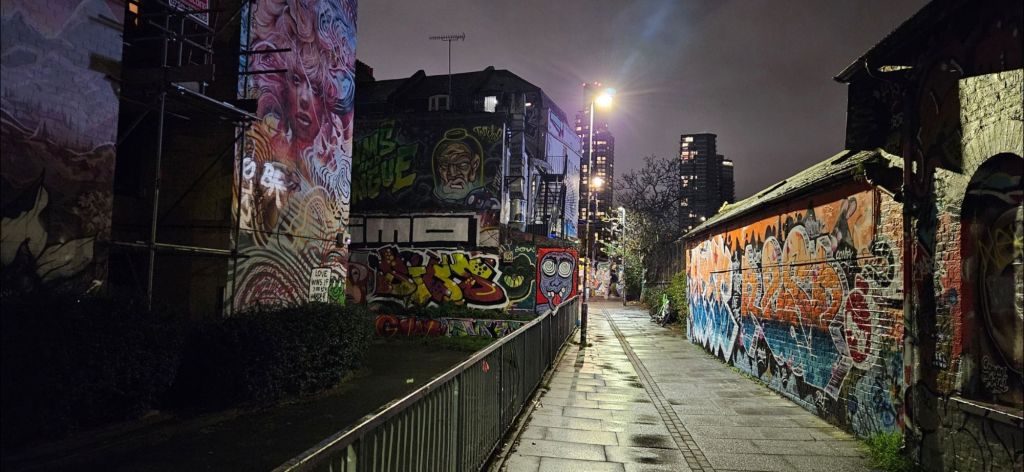
Tonight I went searching for dark East End alleys and streets. But the City of London believes in lighting everything up. Oh well.
Here are some scenes:
A street sale closing up shop
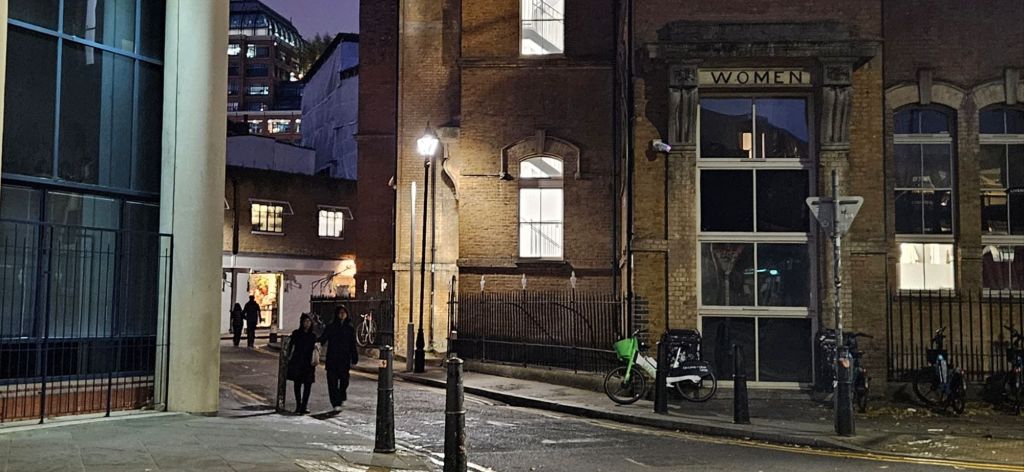
In the photo below, “Why the ‘WOMEN’ sign?” you ask.
In 1868 the Providence Row Night Refuge moved to Crispin Street in Whitechapel. Its manager said this:
“The poverty which exists in the middle of us: some thirty or forty persons die of starvation in London most years while hundreds more sleep on the bridges, in Trafalgar Square or outside the park railings, in the drifting rain or the driving snow.” In the courts and alleys, he said, were families “hungry and cold, who could scarcely support a life of misery, sleeping on the floors with the winter winds seeping through the broken windows.”
The Refuge, which was generally full, provided shelter for 140 men and 112 women.
The folks onstage at Rouleur Live smile a lot. Usually they’re bubbling with life. The power of cycling.
Here you see Matt Stephens interviewing Katie Archibald (centre) and Emma Finucane. They’re British track cyclists.
Katie won a gold medal in the Madison event at the Tokyo 2020 Olympics. She’s 30. Emma won a gold medal in the Team Sprint event at the Paris 2024 Olympics and is the current world champion in the individual Sprint event. She’s 21.
I looked at Katie’s animated face and how she was enjoying her friend Emma. As they talked, I searched the Internet. And what I didn’t know about Katie and her partner Rab …
He went into cardiac arrest while we were lying in bed. I tried and tried, and the paramedics arrived within minutes, but his heart stopped and they couldn’t bring him back. Mine stopped with it.
Oh. My eyebrows rose as I read and kept listening to the folks onstage.
Back on the Internet, Katie said how she’s often been overwhelmed with anxiety on the bike. And her friend has stayed close:
Emma’s been a big influence on me. When we were prepping for the Olympics, we both had this three-event target. She’s very young and very wise. She convinced me of how good it feels to focus on the opportunity and not the threat.
And there, before my eyes, were two fine human beings on display.
***
Rouleur Live ended this afternoon. During the three days, I realized I wanted to talk to five people associated with the event.
1. Ed Pickering – the editor of Rouleur magazine. > “Thank you for the immense contribution you make to cycling. Rouleur is a marvel” > ✓
2. Hannah Walker – a commentator on the Eurosport TV channel and an interviewer at Rouleur Live > “You’re so enthusiastic about cycling. And you draw forth great words from your guests.” > ✓
3. Lachlan Morton – endurance cyclist, rode 14,200 kilometres around Australia in 30 days > “Thank you for inspiring me … not just cycling but in life.” > ✓
4. James Starrt – Rouleur photographer, art director and journalist > “Thank you for ‘Art Cycle’. It broadens the world of cycling far beyond who won the race.” > ✓
(“Art Cycle” is an almost monthly feature in the magazine, featuring cycling-oriented painters and paintings.)
5. Rachel Jary – regular writer of cycling articles in Rouleur > “I love your writing. You bring out the humanity of the people you interview.” > ✓
The main reason I’m in London is to attend Rouleur Live, a three-day convention about professional cycling. About thirty men and women pro’s will be interviewed onstage.
The whole shebang got going last night at the Truman Brewery – an event centre.
I walked fast from dinner because my phone was dying. No phone … no entry. I prayed that I could plug in at Rouleur so I could find my way home.
I wasn’t really present to the cycling world displayed since I was nosing around for an electrical outlet. Once that task was complete, though, I started to drink things in. Hundreds of enthusiasts were lusting over the latest bikes and equipment, sampling the yummies, and sipping the beers. Happy faces at every turn, almost all of them younger than mine. Whatever our stories, we all shared a love.
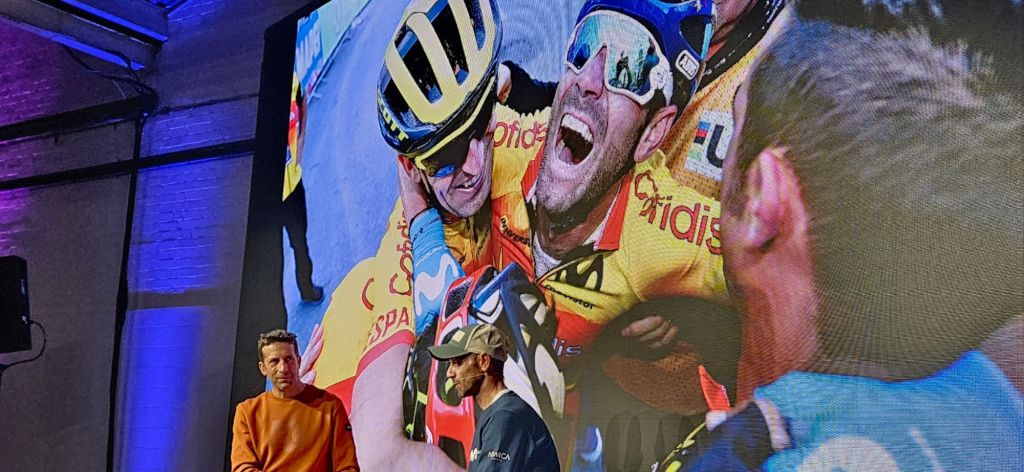
I found a seat in the front row of the main stage, waiting for interview number one. The man of the hour was Alejandro Valverde, a recently retired Spanish cyclist. Alejandro spoke no English but the interviewer was skilled in translation as well as questions. And his appreciation of the cycling legend was clear.
Videos of some Valverde races were shown on the screen as the two of them talked:
Look at that joy!
I remember watching Alejandro on TV in Canada. It was a privilege to experience him live.
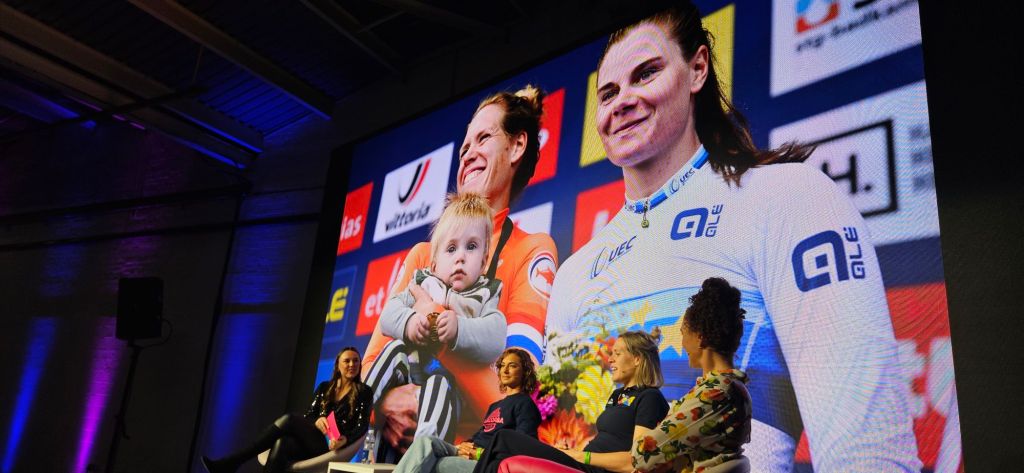
Later in the evening, Ellen van Dijk from the Netherlands and Ashleigh Moolman-Pasio from South Africa were among the guests. Both of them are in their late 30’s and retirement from professional cycling is creeping closer. As well as their personal achievements, Ashleigh and Ellen enjoy playing mom, mentoring their young teammates.
So far on the stage at Rouleur Live, photos suddenly show up on the screen. And here’s a lovely one …
Ellen’s a mom! So cool to see her beaming onstage as well as onscreen. (Ashleigh is second from the left.)
The world of cycling is so much bigger than who won the race
It was 1888. There was so much poverty, disease and violence in London … and hopelessness. Women were often beaten and abandoned by their husbands. In desperation, many of them turned to prostitution.
Sadia, our Jack the Ripper Tour guide, talked to us in front of one of the old lodging houses in the East London neighbourhood of Whitechapel. 19 Princelet Street. People drowned their sorrows with gin and then looked for a place to sleep, so they wouldn’t be killed on the street after passing out.
You could get a room for the night. If you couldn’t afford that, it was four pence for a mattress. If even that was beyond you, two pence would get you a spot on a rope strung across a room. You leaned over and tried to sleep standing up. Sadia told us that’s where the word “hangover” came from. O my God …
The famous story about Jack the Ripper should really focus on the five women he killed and mutilated. They were all prostitutes in Whitechapel, considered scum by polite society, and denied a church burial plot when they died.
In Amsterdam I stood for a long time in front of the house where Anne Frank and her family hid from the Nazis in World War II. I wanted to feel a spot on the Earth where man’s humanity to man happened.
And yet there still are countless places around the globe where horrendous acts unfold. But hardly any of us know about them.
Now in London, I want to be in locations that were part of the Whitechapel murders. Last night Sadia pointed out the Ten Bells tavern where at least two of the victims were regulars – Annie Chapman and Mary Kelly.
I vowed to come back to the corner of Commercial Street and Fournier Street.
And the next day … here I am.
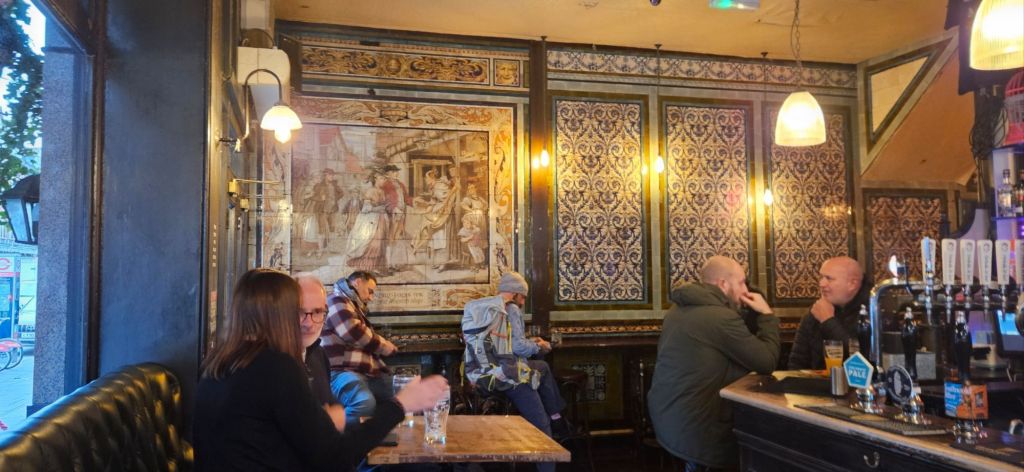
The mural on tile is entitled Spitalfields in Ye Olden Time – Visiting a Weaver’s Shop. It was here when Mary Kelly was enjoying her gin and friends.
Now the pub is filling up mid-afternoon. Lots of guys standing …very few women here. I’m falling into sadness for Mary and Annie.
Mary was Jack’s fifth victim. Powerful friends of hers fought to have her buried in a church graveyard … and it happened. It was a six-mile walk from Christ Church Spitalfields (which I can see through the window) to St. Patrick’s Catholic Cemetery. Many people walked beside Mary’s casket. Thousands lined the route, some of them crying.
Earlier today, I stood in front of Mary’s gravestone. I cried too.
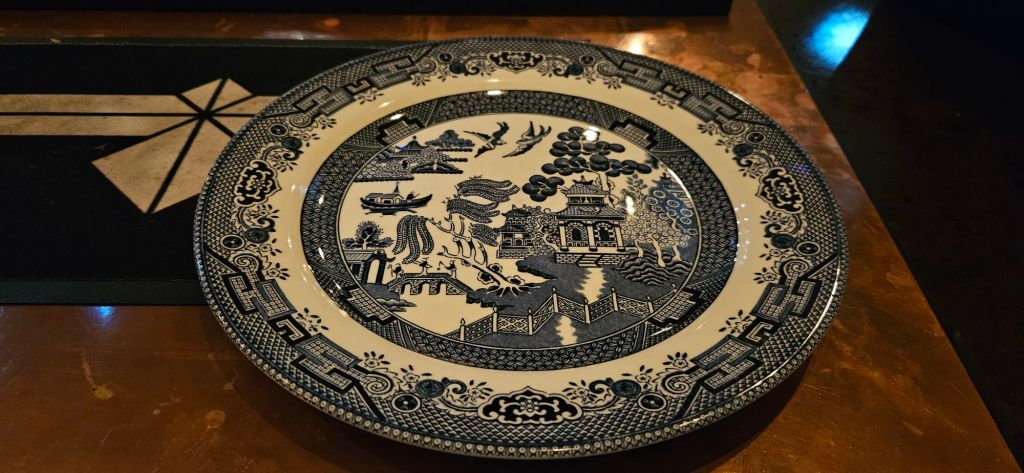
As I was finishing off my meal of pie and mash, I became aware of the plate below. Familiar. And then my eyes spread wide. In front of me was a dinner plate from my 1970 life. I had my server bring me a clean one for you to see:
I was a 21-year-old bus boy in the dining room of the Prince of Wales Hotel in Waterton, Canada. I was basically scared of everyone, and especially the manager – Mr. Hayes. He snarled a lot.
Make sure the birds fly high!
Woe was the bus boy who placed the dinner plate upside down. And it all came back to me yesterday. I’m a lot happier now … 54 years later.
***
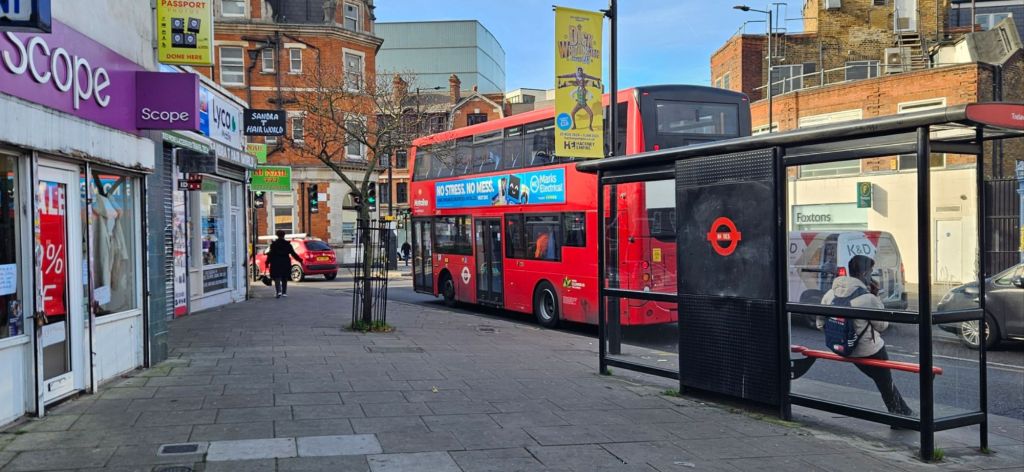
And just now at a sidewalk table of Dilara’s Café. Such a gracious woman serving me. Maybe she’s Dilara. Here’s my view:
In contrast was the force of an impatient driver. Imagine two lanes of traffic, both going the same way. A little further on, the right lane curves to the right and the left one to the left. A driver in the right lane swerves into the left, and then pushes their way into a small space in the right, about six cars further. And everyone is waiting at a red light. All to save a few seconds. (Sigh)
***
Tonight I’m taking a Jack the Ripper Tour in Whitechapel, seeing some of the sites of his horrendous murders. Rarely have I been on location at moments of history.
Seeking a place for dinner near the rendezvous spot, I heard a man chanting above the din of street life. Across the street stood the East London Mosque. I was hungry … but more for experience than food.
Welcomers welcomed me, asked me to take off my shoes, and escorted me to a chair. I had never been inside a Muslim place of worship before but I was invited.
I sat next to 83-year-old Suleman who quietly helped me in the moments when the Imam (~ “Priest”) wasn’t chanting.
Most of the faithful knelt on the floor. Often they would lean forward and touch their forehead to the carpet in reverence to the Divine and the prophet Muhammad.
There was a softness in the air, and after the prayers were completed, a few smiles turned my way … including Suleman.
***
And now I move towards Jack. I’ll share all tomorrow











 Bruce's Blog