For those of you who read yesterday’s post, I sang well last night. My eyes met those of the audience, and I touched the hearts of many.
“Remember When The Music” is a profound creation from Harry Chapin. Here’s a sample:
Remember when the music Was a glow on the horizon of every newborn day And as we sang, the sun came up to chase the dark away And life was good, for we knew we could
***
I’m beginning my career in a care home as a volunteer with residents who have dementia. Yesterday our group of fourteen went for a walk through the old streets near the centre.
(The photo you see here is from the Internet – not us)
The staff don’t know that I spent three years managing volunteers at a hospital in Canada. Yesterday my task was simply to walk beside a resident I’ll call Pascal. Other staff and volunteers were pushing folks in wheelchairs. I smiled as I remembered teaching volunteers how to be gentle and alert with patients in wheelchairs. Ah … the chapters of a life.
Pascal didn’t speak English and my Dutch is a work of very slow progress. Plus there’s the fuzziness in his mind. And the probability that he’s known a particular dialect of Dutch all his life – something that’s incomprehensible in mine.
On the surface of things, Pascal and I weren’t a good match, but there were depths available. I composed short sentences, with grammatical mistakes and incorrect pronunciation. But mostly he got my words. And I know he got my intention to be kind. We smiled a lot.
***
The care home is where I want to be
The residents with dementia are whom I want to be with
I lay in bed this morning worrying about this evening. I’m singing a song called “Remember When The Music” at an open mic session. I sang it a few weeks ago at another venue but now I’m struggling to remember the words.
I love singing to people. And I wonder if this is my future: forgetting the lyrics as I stand on stage. Oh well. I’ll deal with it in my brain and heart. No way am I going to sing while gazing at my phone screen.
As I ate breakfast today at Martens, an old memory surfaced. I was on a spiritual retreat in the Rocky Mountains of Canada. It was evening, and we participants were enjoying a drink in the hotel pub.
I told my neighbours about some emotional issue that was polluting my mind. The woman next to me stood up and said “Do this.”
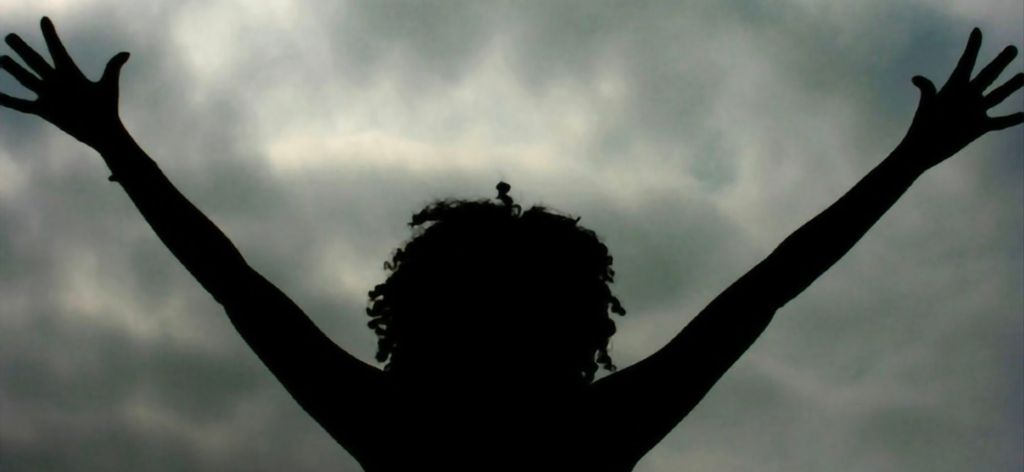
She extended her arm straight ahead at waist level, palm up. Then she slowly raised her hand until it was above her head.
I got it. The words that appeared inside my head weren’t as powerful as seeing the physical movement.
Many times since, my hand has ended up way high in the sky. Today is another opportunity for elevation.
***
And now for a song … Bruce Springsteen wrote My City Of Ruins. His words speak to me:
Now the sweet bells of mercy drift through the evening trees Young men on the corner like scattered leaves The boarded up windows, the empty streets While my brother’s down on his knees My city of ruins My city of ruins
Come on, rise up! Come on, rise up! Come on, rise up! Come on, rise up!
It began in a coffee shop where the heating was broken. Sitting in winter with my four layers of shirt, sweater, down jacket and shell (plus a toque on my head) … shivering.
This isn’t right.
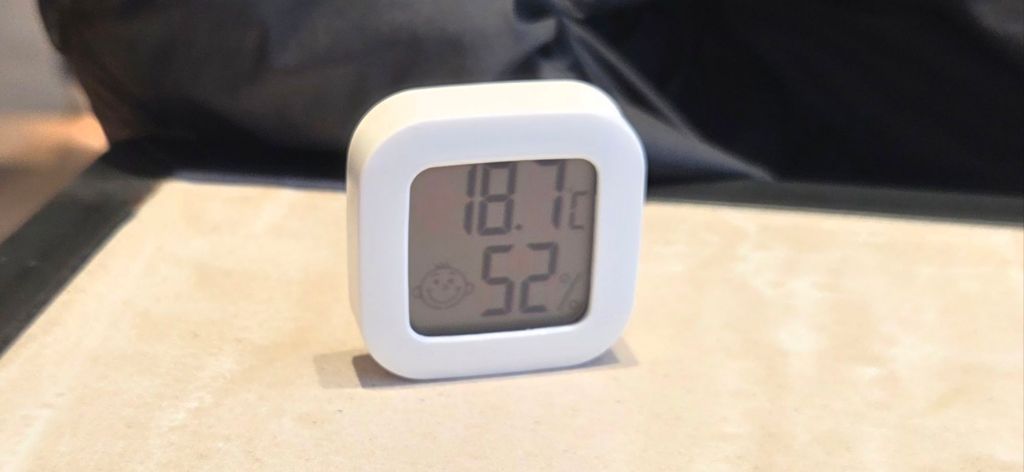
Wondering how cold I really was, I bought a tiny thermometer on Amazon. The answer: 14° Celsius (57° Fahrenheit).
I don’t go to that coffee shop anymore. I’ll probably return when they fix things.
Now I lounge in a new place – Lloyd Coffee Eatery. Very nice … and adequately warm. I’ve started a ritual of pulling out my thermometer as I sit down, even though I’m confident about the heat.
Fifteen minutes ago, fresh from the outside world, the display said 9.3°. The photo shows 18.7°. And now it’s 19.8°, heading to 20.
As well as writing these words, I’ve been observing the progression of numbers. It feels akin to another favourite pastime of mine – watching my clothes turn over in the drier.
Oh … now it’s 20.1!
One more time I am fascinated with my mind. Wouldn’t it be more worthwhile to read an inspiring Buddhist article in Tricycle magazine?
I need your help. I’ll just talk and you listen. Maybe together we can figure this out.
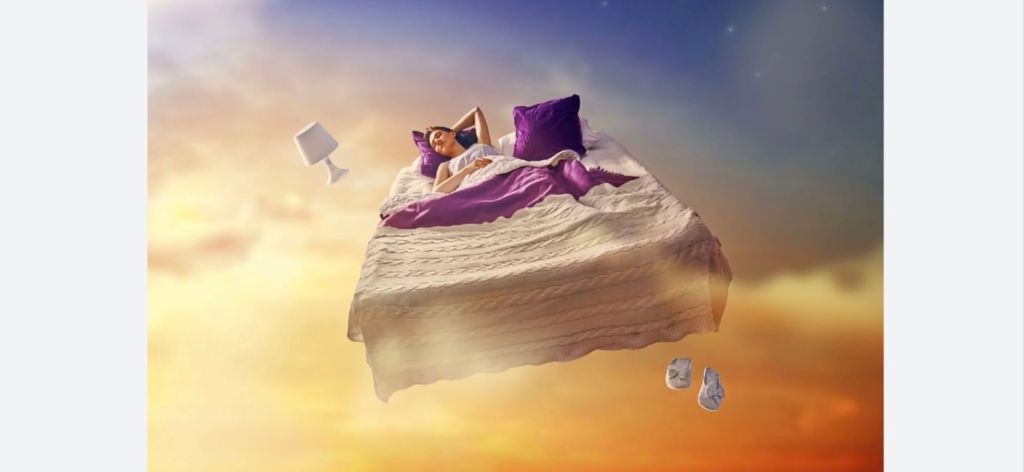
Many nights lately I’ve had the same dream. I’d borrowed someone’s DVD player, and then I lost it. Now I have to buy him or her a replacement. But I can’t remember who I borrowed it from.
No kidding … most mornings I lie in bed trying to remember who the person is. Not knowing if I really borrowed the machine or if my brain made all this up.
Even now, in the light of day, I’m wondering. But as I write, the disorientation isn’t as strong. Maybe because there are people out there (You!) listening to me. My mind is leaning over to the “It’s a dream” side of life. But still not absolutely there.
I consider myself intelligent. But this cloud of uncertainty gives me pause. Shouldn’t a smart guy immediately dismiss the realityof a DVD player being borrowed and lost night after night?
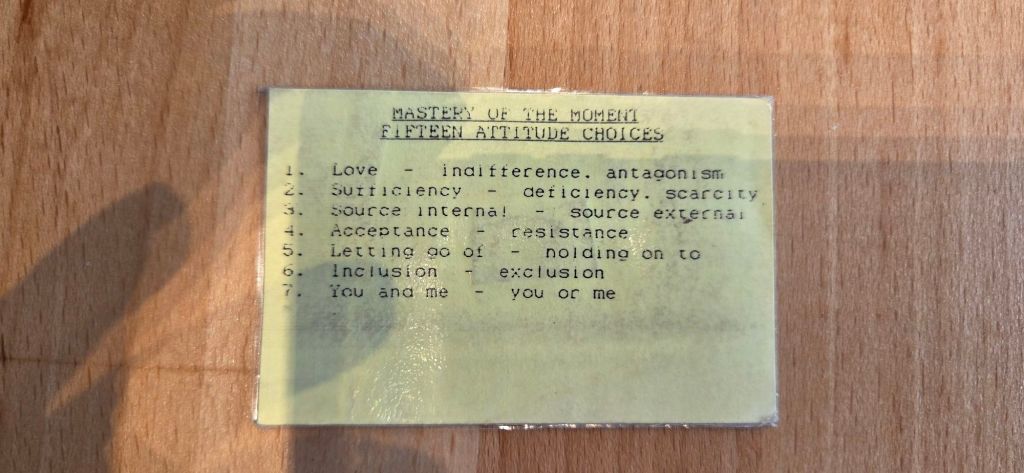
Forty years ago, I gave a speech to high school students. I called it Mastery of the Moment: Fifteen Attitude Choices. I don’t remember their reactions.
I gave them little yellow laminated cards with the choices listed, hoping a piece of paper would make a difference in their lives. I pray that for some of them it did.
I put one of those cards in my wallet. Although particular wallets have come and gone, the card is still there.
Most of the old words still vibrate in my soul. Here they are:
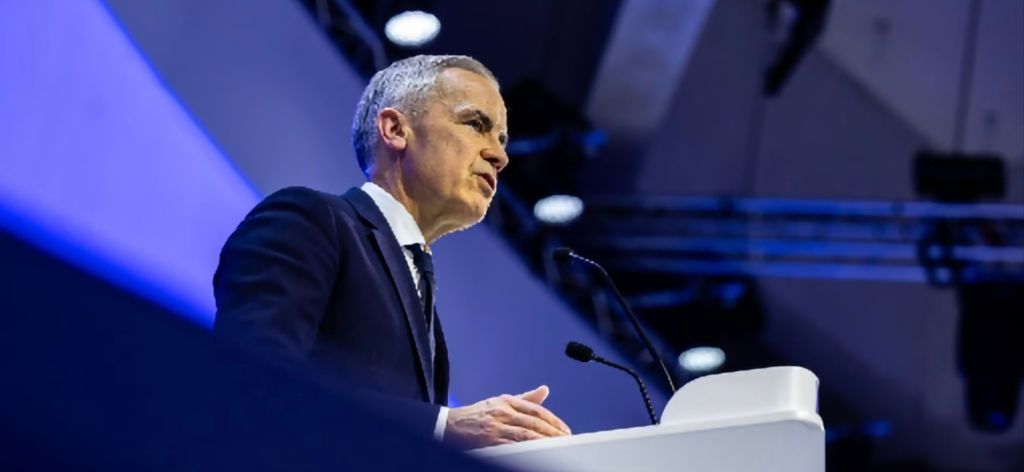
Mark Carney, Prime Minister of Canada, gave a speech to the World Economic Forum on Tuesday, January 20. It will be remembered.
His focus was on co-operation between nations, especially “middle powers” such as Canada.
I think of families: mom, dad, kids … and what truths reside for them in Mark’s words. Here are some excerpts. Each time I see the word “nation”, I’ve changed it to “person”. And “nations” becomes “family members”.
***
Other family members, particularly middle powers like me, are not powerless. They have the capacity to build a new order that embodies our values, like respect for human rights, sustainable development, solidarity, sovereignty and territorial integrity of family members.
There is a strong tendency for family members to go along to get along. To accommodate. To avoid trouble. To hope that compliance will buy safety.It won’t.
…
“In 1978, the Czech dissident Václav Havel wrote:”
Every morning, this shopkeeper places a sign in his window: “Workers of the world, unite!” He does not believe it. No one believes it. But he places the sign anyway – to avoid trouble, to signal compliance, to get along. And because every shopkeeper on every street does the same, the system persists.
Not through violence alone, but through the participation of ordinary people in rituals they privately know to be false.
When even one person stops performing – when the greengrocer removes his sign – the illusion begins to crack.
It is time for family membersto take their signs down.
…
Many family members are drawing the same conclusions. They must develop greater strategic autonomy: in energy, food, critical minerals, in finance and supply chains.
This impulse is understandable. A person that cannot feed itself, fuel itself or defend itself has few options. When the rules no longer protect you, you must protect yourself.
But let us be clear-eyed about where this leads. A world of fortresses will be poorer, more fragile and less sustainable.
It is building the coalitions that work, issue by issue, with family members who share enough common ground to act together. In some cases, this will be the vast majority of family members.
Middle powers must act together because if you are not at the table, you are on the menu.
In a world of great power rivalry, thefamily membersin between have a choice: to compete with each other for favour or to combine to create a third path with impact.
We should not allow the rise of hard power to blind us to the fact that the power of legitimacy, integrityand rules will remain strong – if we choose to wield it together.
I am a stable, reliable person – in a world that is anything but – a person that builds and values family relationships for the long term.
This is the task of the middle family members, who have the most to lose from a world of fortresses and the most to gain from a world of genuine cooperation.
We are taking the sign out of the window.
The old order is not coming back. We should not mourn it. Nostalgia is not a strategy.
But from the fracture, we can build something better, stronger and more just.
That is my path. I choose it openly and confidently.
And it is a path wide open to any family member willing to take it with me.
The Australian Open of professional tennis is underway in Melbourne. Elite athletes are giving everything to vanquish their opponents. Only one woman will win seven matches – the winner of the tournament.
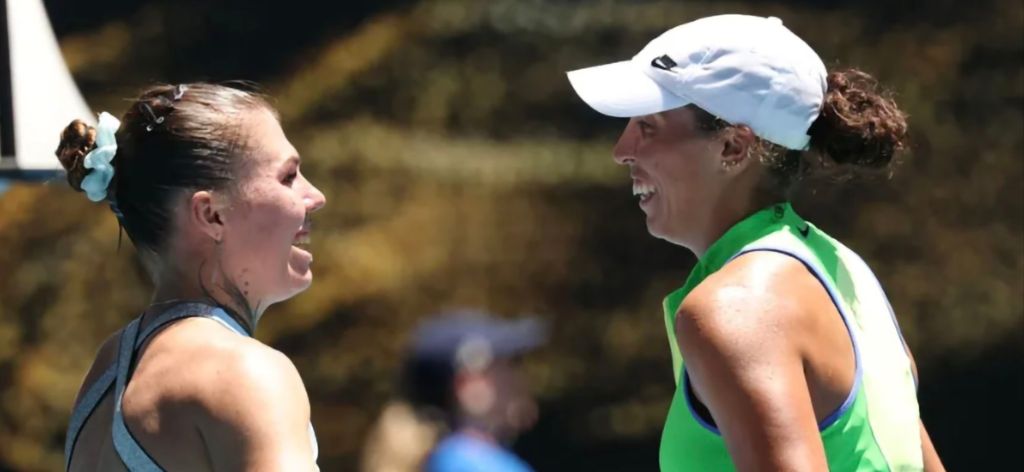
Oleksandra Oliynykova is a tennis player from Ukraine (on the left in the photo). Not well known. Not at the top of the game. Not sought for interviews.
In Kyiv, “There was explosion just near my home, and a drone hit the home just across the road. My apartment was literally shaking because of the explosion … In my apartment, I have no electricity, no water, no heat.”
What type of person does war mould you into? Depends on the person.
In the first round of the Australian Open, Oliynykova was playing Madison Keys from the USA, ranked 9th in the world. Oleksandra is 92nd. It was supposed to be “no contest”.
Here’s what a reporter had to say:
Oliynykova won the crowd over – and for a set, flummoxed Keys – with her game, all dogged defense and creative variety. When she went up a double break with one of the best points of the match, retrieving the American’s hardest strikes before slotting an angled pass past her, an unlikely upset seemed to be brewing.
A story many of us love … an underdog giving the favourite all she could handle.
But there was far more to Oliynykova:
But even as Keys worked out the puzzle, settled her nerves and reeled her opponent in, nothing could stop Oliynykova from relishing her experience. She frequently clapped Keys’ clutch winners and aces, and approached the net after the match with a broad smile on her face.
Such joy – in playing a game she loves, in being stretched by a skilled opponent, in being applauded by thousands of fans. Madison Keys was touched by Oleksandra Oliynykova …
No wonder that Keys also applauded Oliynykova after their hug, and opened her on-court interview by praising her as a “great competitor”, a moment that only broadened the smile of Oliynykova, who was still signing autographs by the side of the court.
“I think it’s not always about winning or losing,” Oliynykova said. “It’s not good in the sport that we are putting too much pressure on the athlete depending only the results, because when you are playing great tennis, you are playing against great opponents, you see high sportsmanship from both sides, you see very kind fans who are cheering for both.”
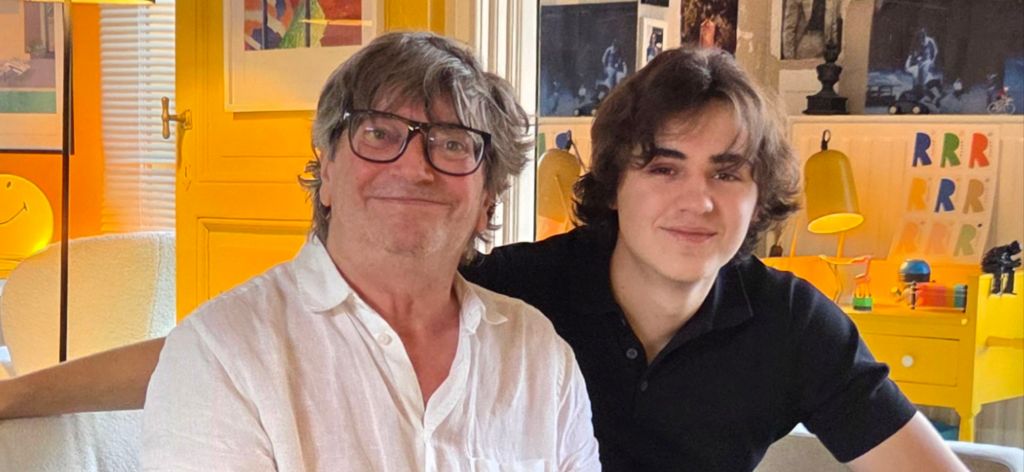
Dirk is my beloved neighbour downstairs. He’s a theatre director … and an all-round creative human being.
Florian is my friend. He’s staying with me for a week as he studies for exams at U Gent.
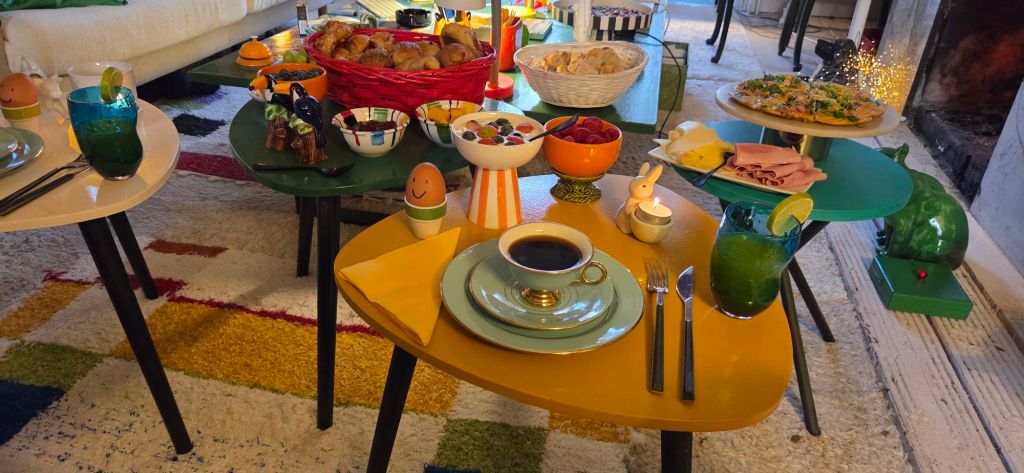
This morning Dirk invited us for breakfast.
Voilà …
So many flavours. So many colours. So much fine conversation.
I especially enjoyed some things that Dirk said. He talked about inspiring young actors to be themselves onstage, to be uniquely great, to reach towards the audience. The words that follow are close to the words he chose.
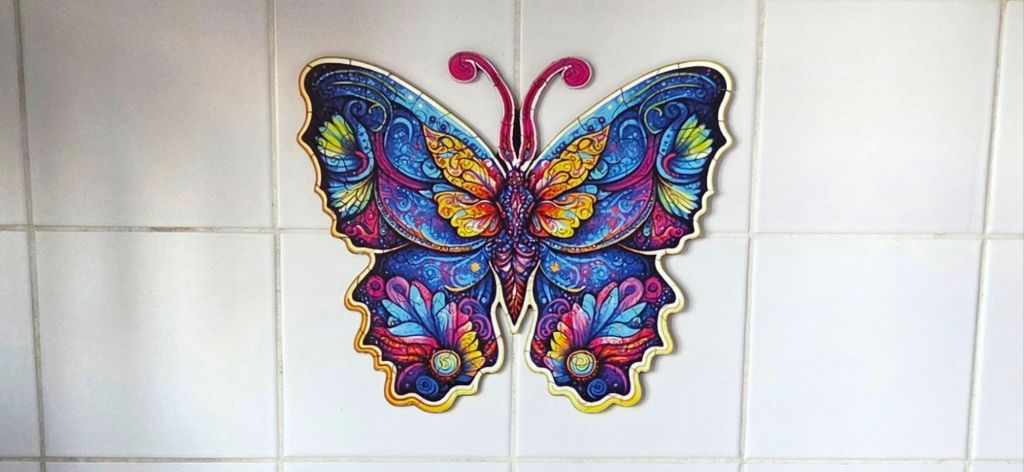
If you chase butterflies, they’ll fly away.
If you create and nurture a lovely garden with the right ingredients, the butterflieswill come, and share their beauty with you.
***
If the earth is hard, dig it up and turn it over. The soil will be dark and moist. Plant your seed here. So many actors, so many different kinds of flowers. We will make them into a bouquet and give it to our audience.
***
I gazed in wonder at the eloquence of the man, but more so at the humanity, the love of all things in the world. Dirk told us he had that as a kid – seeing the majesty of sunlight through the trees, the shapes of houses, the green of grass.
Dirk still sees. Florian and I got to witness the wide spread of his arms.
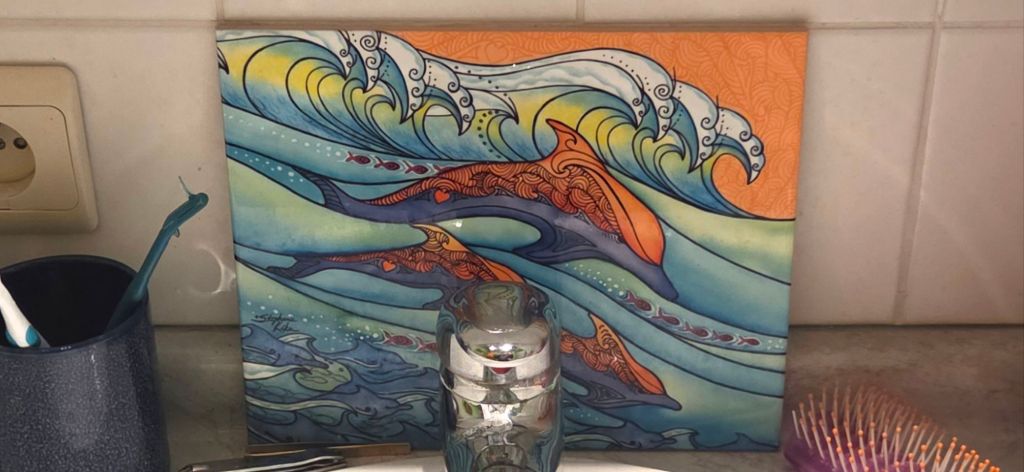
I’ve loved this painting since way back in my Canada days. It shines.
The waves about to crash … the eyes of the dolphins … and O the aquamarine!
Here in Gent, I wanted to see all this every day, to have my breath disappear again and again. But the depth of the beauty often escapes me as I brush my teeth.
In a perfect world, the majesty would flow to my eyes effortlessly. But in my bathroom it requires conscious thought to see the waves. Unless I back up some, the roar of the water remains hidden under a cupboard.
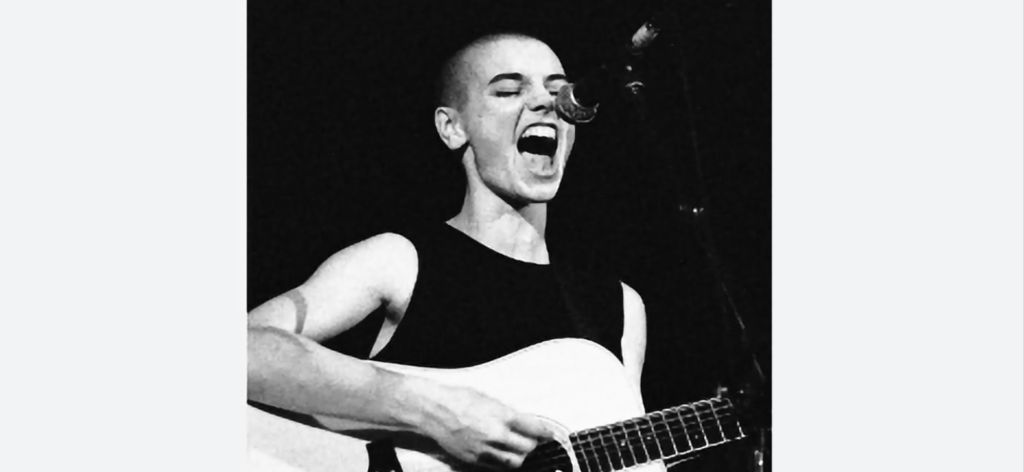
I don’t feel like writing today but four days ago some anonymous person did. She or he told us about Sinéad O’Connor.
I’ll give you the highlights:
Her childhood was brutal. Physical abuse. Emotional trauma. A mother who hurt her. A system that failed her. By age 15, she’d been placed in a Magdalene asylum – institutions where “troubled” Irish girls were sent to be reformed, punished and hidden away.
***
The music industry took one look at her and had notes. Lose weight. Grow your hair long. Wear dresses. Smile more. Look feminine. Be marketable. Sinéad’s response? She shaved her head. Completely bald.
***
Sinéad O’Connor appeared with a shaved head, ripped jeans and combat boots. No apologies. No explanation. No compromise.
***
A woman’s voice – not trying to be pretty or palatable– just furiously, desperately honest. Songs about abuse. About anger. About surviving. About refusing to be broken.
***
The music video was revolutionary in its simplicity: Sinéad’s face. Tears streaming down her cheeks. Nothing else. No dancers. No special effects. No elaborate sets. Just a bald woman crying and singing about loss with such raw vulnerability that it destroyed you.
***
She got death threats. She didn’t care. At the 1991 Grammys, she refused to accept awards. Refused to stand when the national anthem played. People called her ungrateful. Difficult. Crazy. She kept going.
***
She performed an a cappella version of Bob Marley’s “War” – changing the lyrics to be about child abuse rather than racism. Then, staring directly into the camera, she held up a photograph of Pope John Paul II. She tore it in half. “Fight the real enemy,” she said. The audience sat in stunned silence. The backlash was immediate and brutal. Her records were steamrolled by bulldozers on radio station parking lots. The Catholic Church condemned her. Fellow musicians denounced her. Her career in America essentially ended overnight.
But here’s what most people didn’t understand at the time: Sinéad was protesting the Catholic Church’s systematic cover-up of child sexual abuse. This was 1992. Years before the Boston Globe investigation. Decades before the world would fully acknowledge what the Church had done. Sinéad knew. She’d lived it. She’d survived it. And she refused to stay silent – even knowing it would destroy her career. Even knowing the world would hate her for it. She was right. About all of it. But she paid the price anyway.
***
For the next decade, Sinéad released music that barely anyone heard. Performed for audiences that barely existed. Was dismissed as “crazy”, “unstable”, a cautionary tale about what happens when you don’t play by the rules.
***
She struggled with mental health. With trauma. With a world that had punished her for telling the truth. But she never apologized for tearing up that photo. Not once. Not ever. “I’m not sorry I did it,” she said years later. “It was brilliant.”
***
She never stopped being exactly who she was. A woman who refused to be anything other than exactly who she was. Who shaved her head when they told her to grow it. Who spoke truth when they told her to stay silent. Who tore up the photo when they told her to bow down. Who paid the price and never regretted it.
***
Sinéad O’Connor’s story isn’t just about music. It’s about the cost of telling the truth before the world is ready to hear it. It’s about being punished for being right. It’s about choosing authenticity over acceptance, even when authenticity costs you everything. She was told to be pretty. Be quiet. Be grateful. Be normal. Instead, she was Sinéad O’Connor. Bald. Furious. Honest. Uncompromising. Right.

 Bruce's Blog