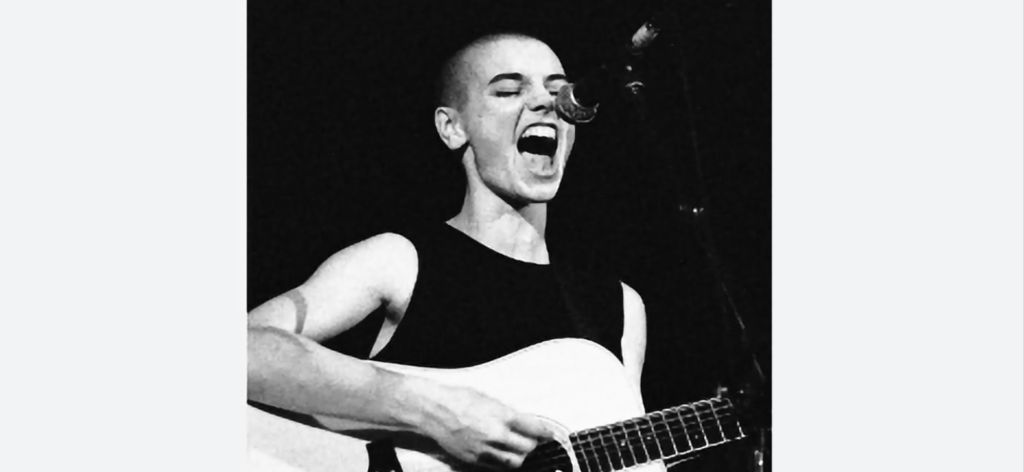
I don’t feel like writing today but four days ago some anonymous person did. She or he told us about Sinéad O’Connor.
I’ll give you the highlights:
Her childhood was brutal. Physical abuse. Emotional trauma. A mother who hurt her. A system that failed her. By age 15, she’d been placed in a Magdalene asylum – institutions where “troubled” Irish girls were sent to be reformed, punished and hidden away.
***
The music industry took one look at her and had notes. Lose weight. Grow your hair long. Wear dresses. Smile more. Look feminine. Be marketable. Sinéad’s response? She shaved her head. Completely bald.
***
Sinéad O’Connor appeared with a shaved head, ripped jeans and combat boots. No apologies. No explanation. No compromise.
***
A woman’s voice – not trying to be pretty or palatable – just furiously, desperately honest. Songs about abuse. About anger. About surviving. About refusing to be broken.
***
The music video was revolutionary in its simplicity: Sinéad’s face. Tears streaming down her cheeks. Nothing else. No dancers. No special effects. No elaborate sets. Just a bald woman crying and singing about loss with such raw vulnerability that it destroyed you.
***
She got death threats. She didn’t care. At the 1991 Grammys, she refused to accept awards. Refused to stand when the national anthem played. People called her ungrateful. Difficult. Crazy. She kept going.
***
She performed an a cappella version of Bob Marley’s “War” – changing the lyrics to be about child abuse rather than racism. Then, staring directly into the camera, she held up a photograph of Pope John Paul II. She tore it in half. “Fight the real enemy,” she said. The audience sat in stunned silence. The backlash was immediate and brutal. Her records were steamrolled by bulldozers on radio station parking lots. The Catholic Church condemned her. Fellow musicians denounced her. Her career in America essentially ended overnight.
But here’s what most people didn’t understand at the time: Sinéad was protesting the Catholic Church’s systematic cover-up of child sexual abuse. This was 1992. Years before the Boston Globe investigation. Decades before the world would fully acknowledge what the Church had done. Sinéad knew. She’d lived it. She’d survived it. And she refused to stay silent – even knowing it would destroy her career. Even knowing the world would hate her for it. She was right. About all of it. But she paid the price anyway.
***
For the next decade, Sinéad released music that barely anyone heard. Performed for audiences that barely existed. Was dismissed as “crazy”, “unstable”, a cautionary tale about what happens when you don’t play by the rules.
***
She struggled with mental health. With trauma. With a world that had punished her for telling the truth. But she never apologized for tearing up that photo. Not once. Not ever. “I’m not sorry I did it,” she said years later. “It was brilliant.”
***
She never stopped being exactly who she was. A woman who refused to be anything other than exactly who she was. Who shaved her head when they told her to grow it. Who spoke truth when they told her to stay silent. Who tore up the photo when they told her to bow down. Who paid the price and never regretted it.
***
Sinéad O’Connor’s story isn’t just about music. It’s about the cost of telling the truth before the world is ready to hear it. It’s about being punished for being right. It’s about choosing authenticity over acceptance, even when authenticity costs you everything. She was told to be pretty. Be quiet. Be grateful. Be normal. Instead, she was Sinéad O’Connor. Bald. Furious. Honest. Uncompromising. Right.
***
To stand alone
Head held high
Eyes meeting the world
 Bruce's Blog