
It’s a small square in Ghent, hundreds of years old. The tram goes right by. People wait there to get on. Others flow by, eager for the eating and shopping.
TripAdvisor knows the place. “Come see.” Here are the comments of one visitor:
Very inviting square in the heart of Ghent. Conviviality is an asset due to the location with many cafes and restaurants.
Sounds like the status quo for this day and age … enjoy your meal. But I’ve discovered something cool about certain todays here in the Sint-Veerleplein:

Consider the art of Alberto Garutti. One particular creation of his is present in several cities of the world – such as Bergamo, Istanbul, Moscow … and Ghent.
In the work Ai Nati Oggi (For Those Born Today), the streetlights of a given place in the city (a street, a square, a bridge) get brighter every time a child is born. The maternity ward in a hospital in the city is equipped with a button that can be pushed by the staff at each new birth; the button makes the streetlight system gradually increase the intensity of the light, a surge that then subsides back to normal in about thirty seconds.
Near the streetlights, on the ground, a stone plaque is placed with the engraved words:
“The streetlights of this place are connected to the maternity ward of the hospital … Every time the light slowly pulsates, it means a child has been born. The work is dedicated to that child, and to the children born today in this city.”
***
I’ve sat there under the monument, thinking about life being born, being lived and dying. And about my new home. At the back of my mind is curiosity about the history of Ghent. Hundreds of thousands of people have lived here over the last five centuries. What were their lives like?
I want to delve into the stories of my adopted city. Why not start with Sint-Veerleplein?
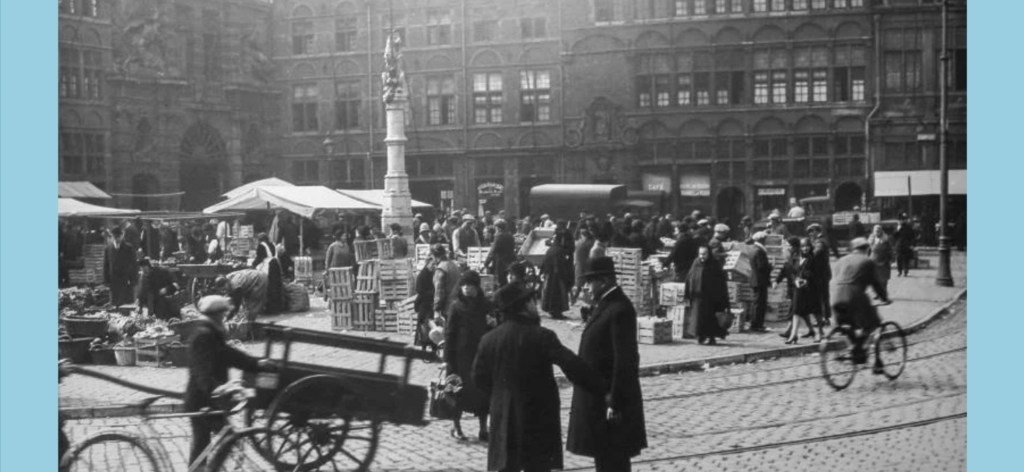
Here’s a photo of Ghentians enjoying this place. Maybe 1900 would be a good guess.
***
And … there’s also a deep dark past here:
From 1407 to the end of the 18th century, the square served as a place of justice for criminals. It was the only punishment place in Flanders for counterfeiters. The fact that counterfeiters were punished here had to do with the location of the count’s mint in nearby Gravensteen [a castle]. The counterfeiters were thrown into a cauldron of boiling oil or boiling water.
On March 17, 1540, nine of the leaders of the Ghent Uprising were beheaded here by order of Emperor Charles V. Five more followed on May 4.
***
Life and death
Cobblestones feeling the feet of past, present and future
 Bruce's Blog